


Writing this on the first couple of days of March, while February is still close enough to feel. This is Month 4 of the FarmSay journey and Month 3 of the lookbacks. If you are new here — welcome. FarmSay is my attempt to build a small, learning-driven agri portfolio from Mysuru, one honest experiment at a time.
February felt different from the months before. November was about laying groundwork. December was field notes — events, trainings, and one very expensive six-minute slot that vanished at IIHR. January brought first roots: the hydroponic system working, microgreens still refusing to cooperate. Ideas were either going to become real decisions this month, or stay stuck in the 'thinking about it' column.
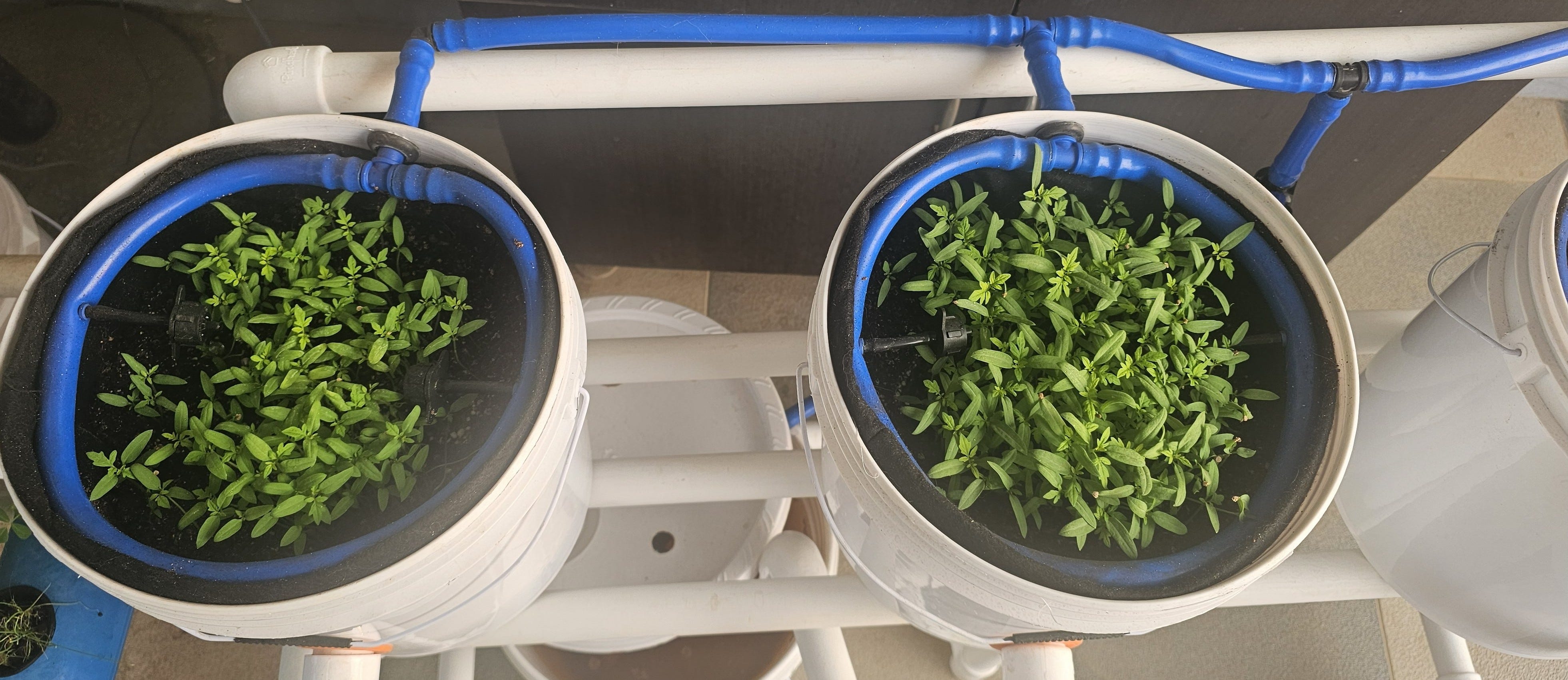
Hydroponics
The month began with a conversation I had been looking forward to since December — HortiRoad2India. I had been trying to understand their Dutch knowledge-sharing framework for a few months now. Talking with them in February finally gave me a clearer picture of what subject-matter support actually looks like in practice, and how their go-to-market playbooks are adapted rather than just handed over.
That conversation made the homework feel more concrete:
What does it actually cost to lease agricultural land at a scale that makes sense?
How close to Bengaluru does it need to be to make logistics and margins work? (Right now my thinking is closer to Bengaluru, given the market size, unless ongoing conversations point to a better balance.)
Can purchase or volume commitments from hotels or cafés be secured early enough to de-risk the early stage?
The CapEx I am looking at is in the 10–12 crore INR range, which is not a number that allows vague thinking. First instinct is B2B — hotels and cafés, where quality matters more than packaging. Once there's predictability of produce, direct-to-customer or farm-gate becomes the next question. But that needs data, not just direction.
A separate thread: a detailed conversation with Dr. Sudhir Sharan, Head of Department at GKVK, on the viability of strawberries specifically. He made a strong case for value-added products over fresh fruit — the shelf life problem is real. We went through OpEx and CapEx together. We are going to keep meeting through March. That feels like a good use of time.
Towards end of the month — positive movement on the VVCE Mysuru / IIT Ropar MoU, and an encouraging response from VVCE to my outreach. More structured conversations are planned for March. I want to see if FarmSay can plug into that kind of ecosystem in some useful way.
On the hands-on side, I ordered a Dutch bucket setup and a 60-planter aeroponics tower from Pindfresh. Seeds are already in. As I write this, they are germinating quietly.
To pull all these threads into a more coherent frame, I signed up for Navarambha, the agri startup incubation program at the University of Agricultural Sciences, Bengaluru. Webinars run March 3–12, with an in-person session on March 13. This feels like the right moment to figure out if any of this actually hangs together as a real venture, not just a list of experiments.
Microgreens
Still very much a “work in progress” month. I ran limited batches of onion, methi, and red radish. The onion batch did the best, which I didn’t expect.
The goal here is not scale. A good week simply means microgreens are on the table — in a salad, a smoothie, or alongside whatever we are cooking. To get more consistent at that, I ordered a new tray and broadcast seeds on March 1. The focus now is rhythm, not output.
Beekeeping
This is the thread that feels most tangible right now. Our first two hives should arrive in the first week of March, and they will start on the home terrace. The plan is to learn at home first. Get the basics right. Then look at expanding — through farmers I know, or through Samrudhi Agri Farms if that conversation develops.
In February, Ashakiran and I attended an in-person workshop with Apoorva B V (Beeman_India). The clearest takeaway: you cannot understand a hive without managing one — steadily, sincerely, over time.
Over the longer term, honey is only part of what interests me. Value-added products — beeswax, royal jelly — are on the horizon, but only once hive management is genuinely under control. When the hydroponic systems are running, having bees nearby for pollination is a natural next step.
Bee9 Training Institute is right here in Mysuru — proper training facility, post-harvest equipment, a lab. All under one roof. Should have found this earlier. Met the founder, MACK Prasad. He cleared up a few things I had been getting wrong. They are working toward international standards in Indian beekeeping — didn't expect to find that in Mysuru.
On the community side, I opened a conversation with our Residents Welfare Association about making the neighborhood more pollinator-friendly. Small step, but worth following through on.
And then the algorithm delivered: a product called “Futuristic Beehive” appeared on my feed. Good design, premium price, free worldwide shipping at the time. Homework now: understand the customs angle — and whether someone in India could build something along similar lines.
Sheep, Goats, and the Mushroom Pause
Samrudhi Agri Farms ran two sheep-and-goat workshops in February, with the next one planned for late March after exam season. A conversation with the founder stretched beyond livestock into hydroponics too — which is exactly the kind of cross-linking I want to see more of.
Mushrooms stayed in the “no movement” column. No cultivation progress, and the IIHR refund is still unresolved. I haven't written mushrooms off. First question: is a home terrace setup even feasible here in Mysuru? If yes, then — does it fit the rest of the FarmSay stack, or not? I'd rather know it doesn't work because I tried it, not because I got stuck on a refund.
Wrapping Up February
The month’s scorecard reads mixed. But as a learning journal entry, it feels more like a portfolio taking shape. Two hives on order. Hydroponic systems germinating on the terrace. Microgreens inching toward a weekly rhythm. Navarambha on the calendar.
Progress is still rarely linear here — which, if December taught me anything, is exactly how it goes.
If there is something specific from this month you want me to dig into — the economics, the gear, the people, or the decisions — drop a comment or hit reply. If something here is close to what you're thinking about too, hit reply.
Subscribe to get FarmSay Field Notes in your inbox: short, honest breakdowns of real farm experiments, mistakes, and small wins from our corner of Mysuru.
Catch up on previous lookbacks:
FarmSay this Jan: First Roots

January was high on experiments: good results from the Ayozari hydroponics system, and mixed, often frustrating, microgreen batches.
FarmSay this Dec: Field Notes

Publishing this a couple of days into January, while the December details are still fresh. This is a quick look back at what the month actually looked like on the ground.
